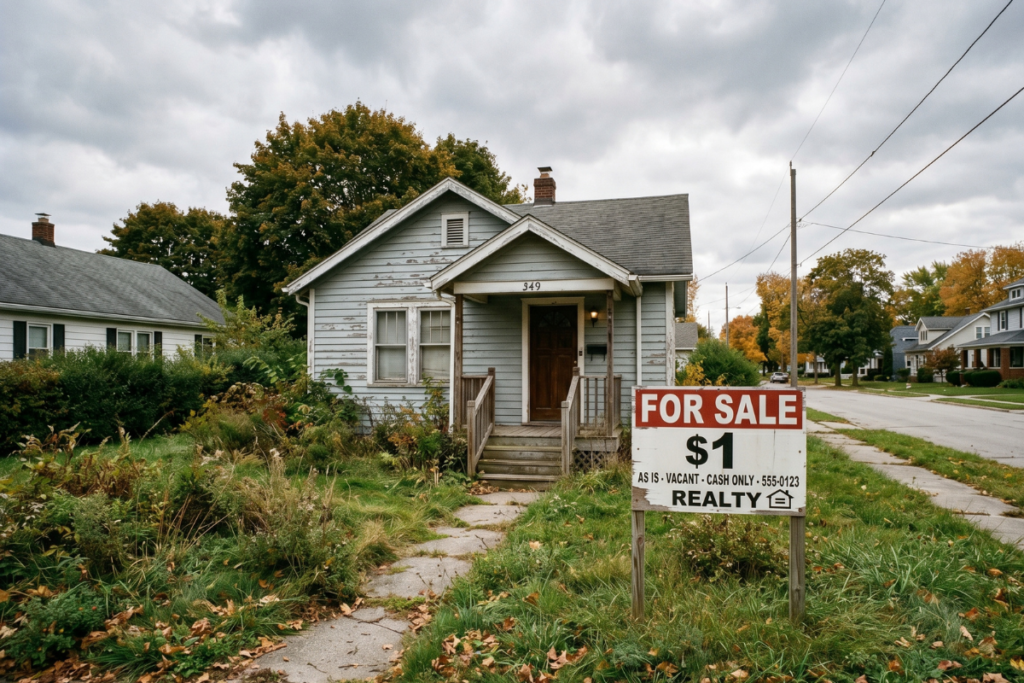
It sounds like a typo. A house — with walls, a roof, a yard — selling for just one dollar. But this is not fiction. It has happened across the United States more times than most people realize, and the stories behind these sales are as fascinating as the price tags themselves.
So how does a home end up selling for $1? And could it ever happen to you?
Let’s dig in.
How Does a House End Up Selling for $1?
Before we get to the stories, it helps to understand the mechanics.
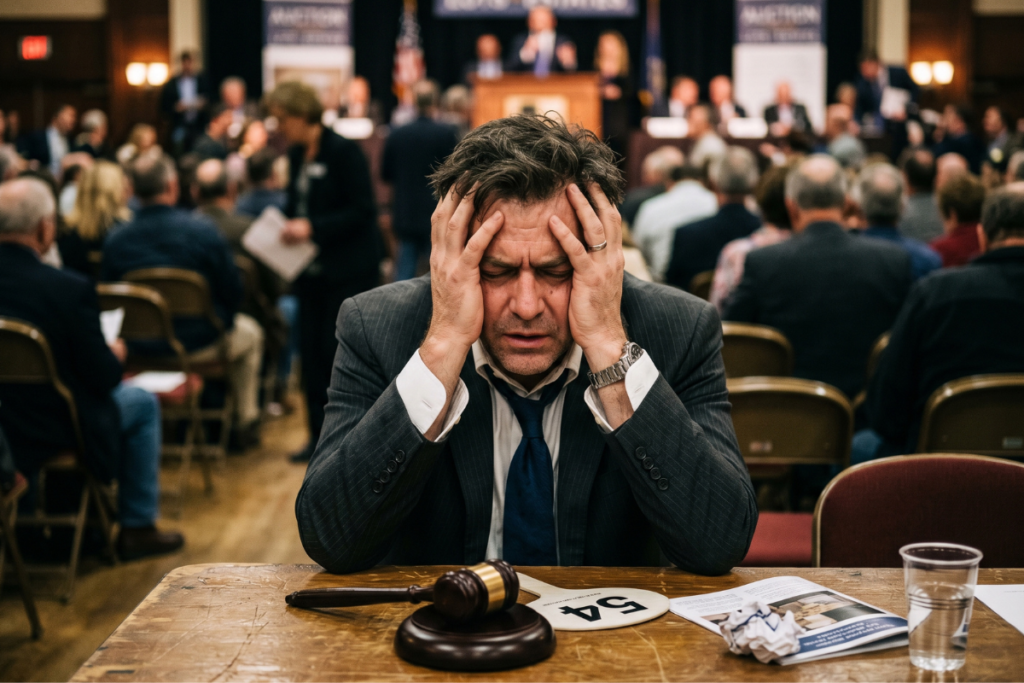
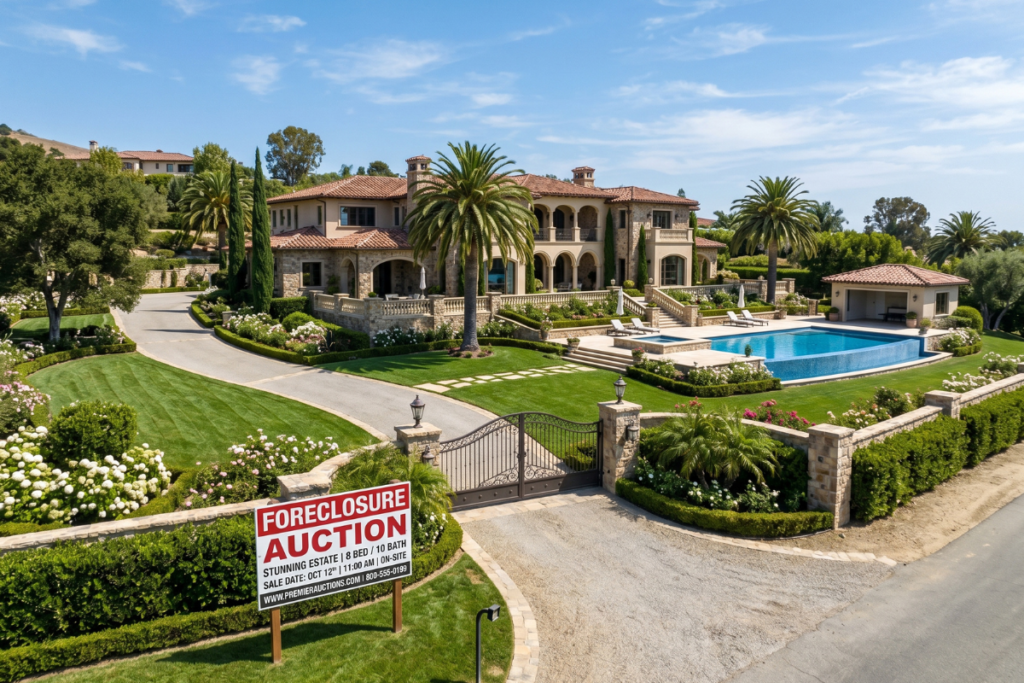
At a foreclosure auction, properties are sold to the highest bidder. The process starts at a minimum bid — usually the amount the lender is owed on the mortgage. But here’s the thing: if nobody shows up to bid, or if the minimum bid isn’t met, the property can be taken back by the lender or the local government.
When that happens repeatedly — when a property sits unsold through multiple auctions — local governments sometimes resort to drastic measures. They list the property for a symbolic price, like $1, just to get it off their books, back on the tax rolls, and into the hands of someone who will actually take care of it.
That’s where the $1 house comes from.
The Detroit $1 House Program
No city is more associated with $1 homes than Detroit, Michigan.
After decades of population decline and economic hardship, Detroit found itself with tens of thousands of abandoned and tax-delinquent properties. Entire blocks sat empty. Houses were crumbling. The city was losing tax revenue and spending money maintaining properties nobody wanted.
In response, the Detroit Land Bank Authority launched programs that made properties available for as little as $1 — with conditions. Buyers had to commit to renovating the home within a set timeframe and living in it as their primary residence. The goal wasn’t just to sell houses — it was to bring neighborhoods back to life.
Thousands of properties went through this program. Some buyers transformed rundown houses into beautiful homes. Others underestimated the cost of repairs and walked away, leaving the properties in worse shape than before.
The lesson? A $1 price tag doesn’t mean a $1 investment. Renovation costs can easily run into tens of thousands of dollars.
The Baltimore $1 Homesteading Program
Detroit wasn’t alone. Baltimore, Maryland ran one of the earliest and most well-known $1 house programs in American history — the Homesteading Program, which began in the 1970s.
The concept was simple: the city would sell abandoned rowhouses for $1 to buyers who agreed to renovate them and live in them for at least 18 months. The program was so popular that a lottery was held to determine who got the chance to buy.
Many of those $1 rowhouses in Baltimore are now worth hundreds of thousands of dollars. Some of the neighborhoods that were saved by the homesteading program are among the most desirable in the city today.
Not bad for a dollar.
What Happens at Auction When Nobody Bids?
Outside of city programs, $1 sales can also happen at traditional foreclosure auctions — simply because nobody shows up.
Imagine a rural property in a declining county. The house needs a new roof, the plumbing is a mess, and it’s located 40 miles from the nearest town. The bank opens the bidding. Nobody raises their hand. The bank tries again at a lower minimum. Still nothing.
At some point, the lender just wants out. The property gets transferred to a government land bank or listed at a nominal price — sometimes as low as $1 — just to move it.
These situations are rare in hot real estate markets, but they’re surprisingly common in economically distressed areas across the Midwest, the South, and rural parts of the Northeast.
Could You Buy a $1 House?
Technically, yes. But here’s what you need to know before you get too excited:
The house will need serious work. No property in good condition sells for $1. You’re looking at homes with structural damage, mold, outdated electrical systems, or worse. Renovation budgets of $50,000 to $150,000 are not unusual.
There are usually conditions attached. Most $1 programs require you to live in the home, renovate it within a specific timeframe, and keep it up to code. Fail to meet those conditions and you could lose the property.
Location matters enormously. A renovated home in a neighborhood with no demand is still a hard sell. Research the local real estate market before committing to any $1 purchase.
Competition can be surprisingly fierce. Word gets out. Some $1 programs receive hundreds of applications for a single property.
The Real Takeaway
The $1 house is one of the most compelling curiosities in American real estate — proof that the foreclosure auction market operates by its own rules, and that extraordinary deals are possible for buyers who know what they’re doing.
But every $1 house comes with a story. Sometimes it’s a story of a neighborhood brought back from the edge. Sometimes it’s a cautionary tale about a buyer who didn’t do their homework.
At Finanovice, we believe in knowing the full story before you bid.
Quick Recap
- $1 home sales happen through city programs and at auctions where no one bids
- Detroit and Baltimore are the most famous examples of organized $1 home programs
- The purchase price is $1 — but renovation costs can reach six figures
- Conditions and requirements are always attached to these deals
- Research, planning, and realistic budgeting are essential
Want to learn more about how foreclosure auctions work before you consider bidding on any property? Read our beginner’s guide: [How Foreclosure Auctions Work →]
Stay curious. Stay smart. That’s the Finanovice way.
Disclaimer: This article is for educational purposes only and does not constitute financial or legal advice. Always consult a qualified professional before making any real estate investment decisions.