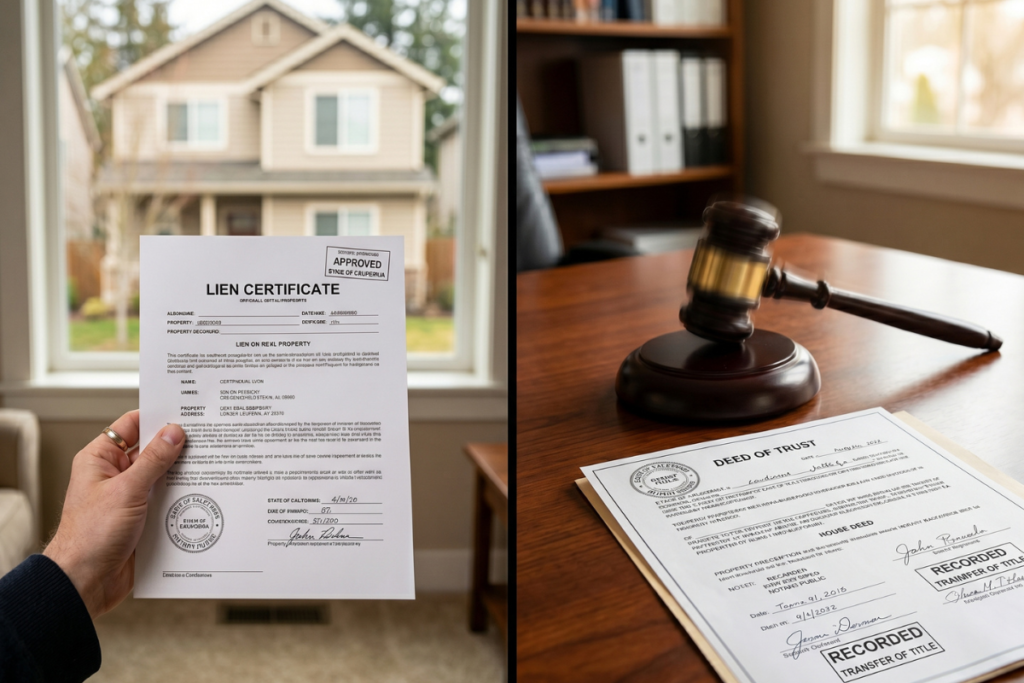
If you’ve been researching property auctions in the United States, you’ve probably come across two terms that sound similar but work very differently: tax lien auctions and tax deed auctions.
Most beginners confuse the two — and that confusion can lead to some very costly mistakes. Understanding the difference between them is one of the most important steps you can take before you ever place a bid.
In this guide, we’ll break down exactly what each one is, how they work, and which one might be right for you as a beginner.
Why Do Tax Auctions Exist?
Before we get into the differences, let’s understand why these auctions happen in the first place.
Every property in the United States owes property taxes to the local government — the county, city, or municipality where it’s located. These taxes fund schools, roads, emergency services, and public infrastructure.
When a property owner stops paying those taxes, the government doesn’t just shrug and move on. It has powerful tools to recover the money it’s owed. Two of those tools are the tax lien and the tax deed — and both of them involve public auctions open to investors and buyers.
What Is a Tax Lien Auction?
A tax lien is a legal claim that the government places on a property when the owner fails to pay their property taxes.
At a tax lien auction, the government sells that claim — not the property itself — to a third-party investor. In other words, you’re not buying the house. You’re buying the right to collect the debt.
Here’s how it works step by step:
Step 1 — The owner falls behind on taxes. The county places a tax lien on the property.
Step 2 — The lien goes to auction. Investors bid on the lien. In most states, the bidding works in reverse — investors compete by offering to accept the lowest interest rate on the debt.
Step 3 — You pay the back taxes. If you win, you pay the overdue taxes on behalf of the property owner. The government gets its money. You get the lien certificate.
Step 4 — The owner must redeem the lien. The property owner now owes YOU the back taxes — plus interest. They have a set period (called the redemption period) to pay you back. This period typically ranges from six months to three years, depending on the state.
Step 5 — If the owner doesn’t pay… If the redemption period expires and the owner still hasn’t paid, you may have the right to initiate foreclosure proceedings and potentially take ownership of the property.
The appeal of tax liens
The interest rates on tax liens can be very attractive — ranging from 8% to as high as 36% per year, depending on the state. Many investors use tax liens purely as a fixed-income investment, with no intention of ever owning the property.
The risk
Most property owners do redeem their liens. You may never get the property. And if the property is in poor condition or has other debts attached to it, taking ownership through foreclosure can be more trouble than it’s worth.
What Is a Tax Deed Auction?
A tax deed auction is a different animal entirely.
When a property owner fails to pay taxes for an extended period — and the redemption period has expired — the government can take ownership of the property and sell it directly to the public. That sale is a tax deed auction.
At a tax deed auction, you are buying the property itself, not a lien. The winning bidder receives a tax deed — a legal document that transfers ownership of the property.
Here’s how it works:
Step 1 — The owner stops paying taxes. After a set number of years (varies by state), the government moves to seize the property.
Step 2 — The property goes to auction. The government lists the property and opens bidding to the public. The minimum bid is usually the amount of back taxes owed, plus fees and interest.
Step 3 — You bid and win. The highest bidder wins the property and receives the tax deed.
Step 4 — You own the property. Unlike a tax lien, there is no redemption period in most tax deed states. Once the auction is over and the deed is transferred, the property is yours.
The appeal of tax deeds
You can acquire real property — sometimes significantly below market value — through a straightforward public auction process.
The risk
Tax deed properties are sold as-is, with no guarantees about condition, occupants, or title history. You need to do your homework carefully before bidding.
Tax Lien vs Tax Deed: Side-by-Side Comparison
| Tax Lien | Tax Deed | |
|---|---|---|
| What you buy | The debt (lien) | The property |
| Do you own the house immediately? | No | Yes |
| Redemption period? | Yes (owner can pay you back) | Usually no |
| Main appeal | Interest income | Property ownership |
| Risk level | Lower | Higher |
| Potential reward | Interest payments | Property at below-market price |
| Best for | Passive investors | Active real estate buyers |
Which States Have Which Type?
The United States is divided into tax lien states, tax deed states, and a handful of hybrid states that use elements of both.
Tax lien states include: Florida, Arizona, Colorado, Illinois, New Jersey, and others.
Tax deed states include: California, Texas, Michigan, Oregon, and others.
Hybrid states include: New York, Connecticut, and a few others that use both mechanisms depending on the situation.
Before you attend any tax auction, you need to know which type your state uses. The rules, timelines, and procedures vary significantly.
Which One Is Right for a Beginner?
If you’re just getting started in the world of property auctions, here’s a general guideline:
Tax lien auctions may be more approachable for beginners who want to dip their toes in without committing to property ownership. The process is more structured, the risk is somewhat lower, and the returns can be predictable.
Tax deed auctions are better suited for buyers who are ready to own and manage — or renovate and resell — a physical property. The potential upside is higher, but so is the complexity.
In either case, the advice is the same: start by attending a few auctions as an observer before you ever bid. Watch how the process works. Talk to experienced investors. Get comfortable before any money is on the line.
Quick Recap
- Tax lien auctions sell the government’s claim on unpaid taxes — you buy the debt, not the house
- Tax deed auctions sell the property itself after the owner has lost it for non-payment
- Tax liens offer interest income; tax deeds offer property ownership
- The rules vary significantly by state — always research your local laws
- Both types can offer real opportunities for prepared, informed buyers
New to property auctions? Start with our beginner’s guide: [How Foreclosure Auctions Work →]
Stay curious. Stay smart. That’s the Finanovice way.
Disclaimer: This article is for educational purposes only and does not constitute financial or legal advice. Always consult a qualified professional before making any real estate investment decisions.